Google Workspace logo

Beyond AI Optimism

Five ways to move your business from saving time to sparking innovation

Google Workspace graphic

Welcome letter from Google

A green-background document titled "Welcome from Google" discusses the transformative impact of AI on work. The text begins by stating that AI has moved to the center of how people ideate, create, and collaborate, but only about 3% of companies have truly transformed with AI. It introduces a global research study, partnered with Hypothesis Group, involving over 2,500 leaders and knowledge workers to understand the state of AI transformation. Emerging themes include: * **Executive optimism outpaces reality on the ground:** Executives are more likely than employees to say AI has had a significant business impact, while employees are often held back by a lack of top-down strategy, training, and a clear roadmap. * **Time savings are the fuel, not the finish line:** Most companies see measurable value in time savings and productivity, but the strategic goal is innovation—inventing and shipping better products and services faster. * **Real change is possible:** With the right tools and approaches, organizations can fundamentally transform work, helping employees boost creativity, focus on important work, and accelerate the pipeline from idea to market. Google states its belief that AI should make work easier and more impactful, not more complicated, highlighting tools like Google Workspace with Gemini and Gemini Enterprise. The document concludes with a signature from Derek Snyder, Director of Product Marketing, Google Workspace.

Introduction

As organizations race to adopt AI, there’s a clear gap between aspiration and achievement. While many leaders say AI has already made a significant impact at their companies, employees often experience it as experimental and fragmented. Overcoming this disconnect is foundational to transforming work with AI.

To better understand how organizations can move from AI experimentation to transformation, we partnered with Hypothesis Group to conduct a global, multi-phase study of more than 2,500 business decision-makers and knowledge workers (referred to as employees) from mid-market and enterprise organizations (300+ employees) spanning different geographies (US, UK, India, Japan, Brazil, and France), industries, and roles within the organization. All of the organizations we surveyed already have some level of AI deployment in place. See the full methodology for details (page 20).

To complement these findings, we also spoke with three AI experts about how they're seeing organizations transform with AI:

Nirit Cohen Future of work strategist & keynote speaker
Dr. Terri Horton Al Strategy & Workforce Transformation Consultant, Work Futurist, Microsoft/LinkedIn Learning Global AI Skills Initiative Course Author, Instructor UCLA Extension
Associate Director at Leverhulme Centre for the Future of Intelligence, Senior Research Associate at the University of Cambridge, AI Ethics and Cognitive Science specialist

Key Findings

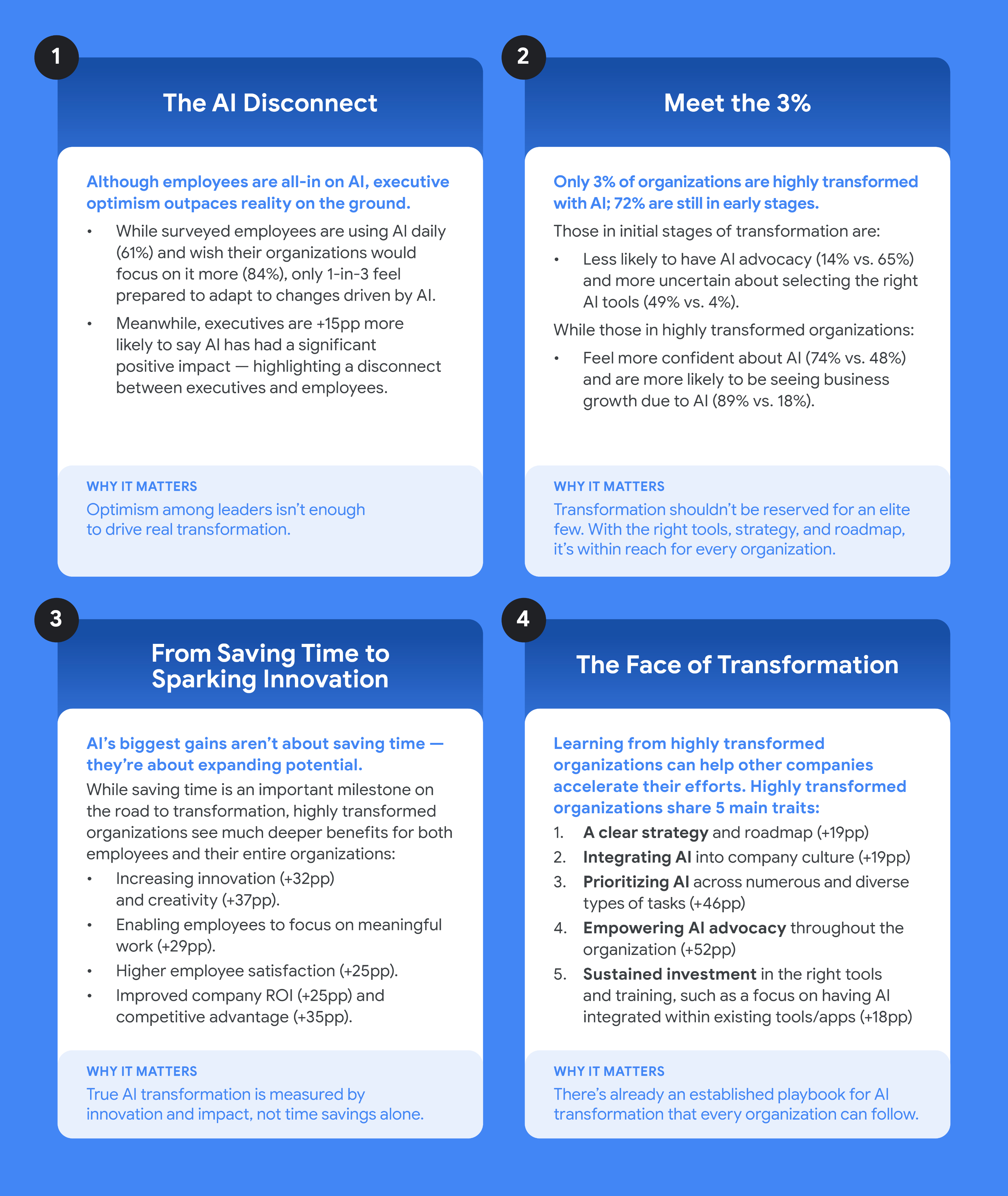
The image is a document titled "Key Findings" that summarizes four main points about AI transformation in organizations. 1. **The AI Disconnect:** Despite employees being "all-in" on AI (61% using it daily, 84% wanting more organizational focus), only 1 in 3 feel prepared for AI-driven changes. Executives are 15 percentage points more likely to report a significant positive impact from AI, highlighting a disconnect between leadership and employees. The takeaway is that executive optimism alone is insufficient for driving real transformation. 2. **Meet the 3%:** Only 3% of organizations are "highly transformed" with AI, while 72% are in the early stages. Highly transformed organizations are much more likely to have AI advocacy (65% vs. 14%), feel confident about AI (74% vs. 48%), and report business growth due to AI (89% vs. 18%). The takeaway is that transformation is achievable for every organization with the right tools, strategy, and roadmap. 3. **From Saving Time to Sparking Innovation:** AI's biggest gains are in expanding potential, not just saving time. Highly transformed organizations report deeper benefits such as increased innovation (+32 pp) and creativity (+37 pp), enabling employees to focus on meaningful work (+29 pp), higher employee satisfaction (+25 pp), and improved company ROI (+25 pp) and competitive advantage (+35 pp). The takeaway is that true AI transformation is measured by innovation and impact, not time savings alone. 4. **The Face of Transformation:** Highly transformed organizations share five main traits: a clear strategy and roadmap (+19 pp), integrating AI into company culture (+19 pp), prioritizing AI across numerous and diverse types of tasks (+46 pp), empowering AI advocacy throughout the organization (+52 pp), and sustained investment in the right tools and training, such as integrating AI within existing apps (+18 pp). The takeaway is that an established playbook for AI transformation exists for every organization to follow.

The AI Disconnect

Why is there a gap between executive optimism and employee reality when it comes to AI transformation?

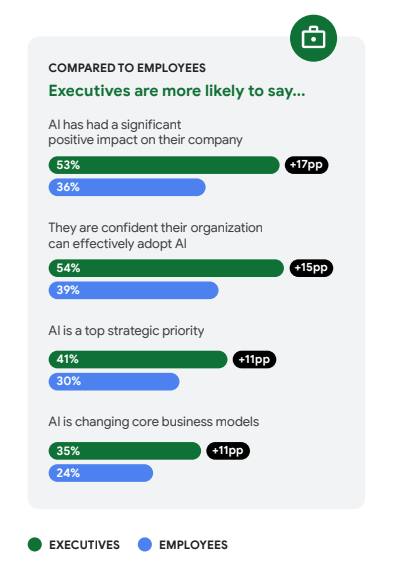
The image is a page from a report titled "The AI Disconnect," which explores the difference between executive optimism and employee reality regarding AI transformation. The text states that executives are "bullish" on AI's potential, confident in adoption, and see it as a cornerstone of transformation, believing it has already had a big impact. In contrast, employees, despite most using AI daily and calling it essential for their careers, have a significantly lower perception of AI's existing impact and future prospects. A bar chart illustrates this disconnect, showing that executives are consistently more likely than employees to agree with key statements: * **AI has had a significant positive impact on their company:** 53% of executives agree compared to 36% of employees (+17 percentage points). * **They are confident their organization can effectively adopt AI:** 54% of executives compared to 39% of employees (+15 percentage points). * **AI is a top strategic priority:** 41% of executives compared to 30% of employees (+11 percentage points). * **AI is changing core business models:** 35% of executives compared to 24% of employees (+11 percentage points). The bottom of the image shows a photo of a woman, presumably a business leader, speaking in a meeting to a group of people.
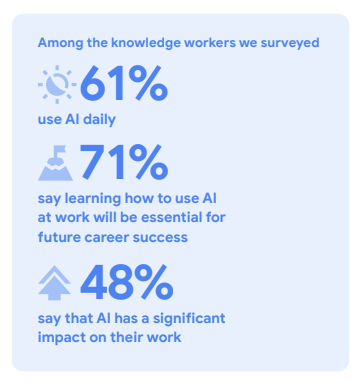
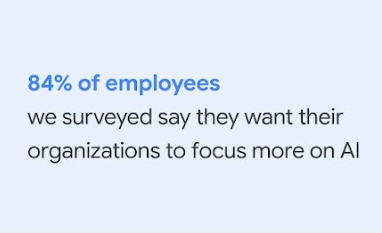
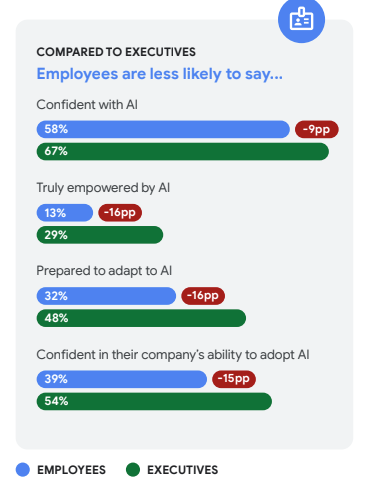
The image is a page from a report titled "Beyond\_AI\_Optimism\_Dec\_2025\_7.jpg" that focuses on employee demand for AI prioritization. The document highlights that **84% of surveyed employees want their organizations to focus more on AI**. It notes that while most knowledge workers (61%) use AI daily, and 71% say learning to use AI will be essential for future career success, only 48% say AI has a significant impact on their work. A comparison chart reveals that employees generally feel less prepared and confident about AI than executives: * **Confident with AI:** Employees are 9 percentage points less likely to agree (58% vs. 67%). * **Truly empowered by AI:** Employees are 16 percentage points less likely to agree (13% vs. 29%). * **Prepared to adapt to AI:** Employees are 16 percentage points less likely to agree (32% vs. 48%). * **Confident in their company's ability to adopt AI:** Employees are 15 percentage points less likely to agree (39% vs. 54%). A photo at the top shows a man looking intently at a computer screen.
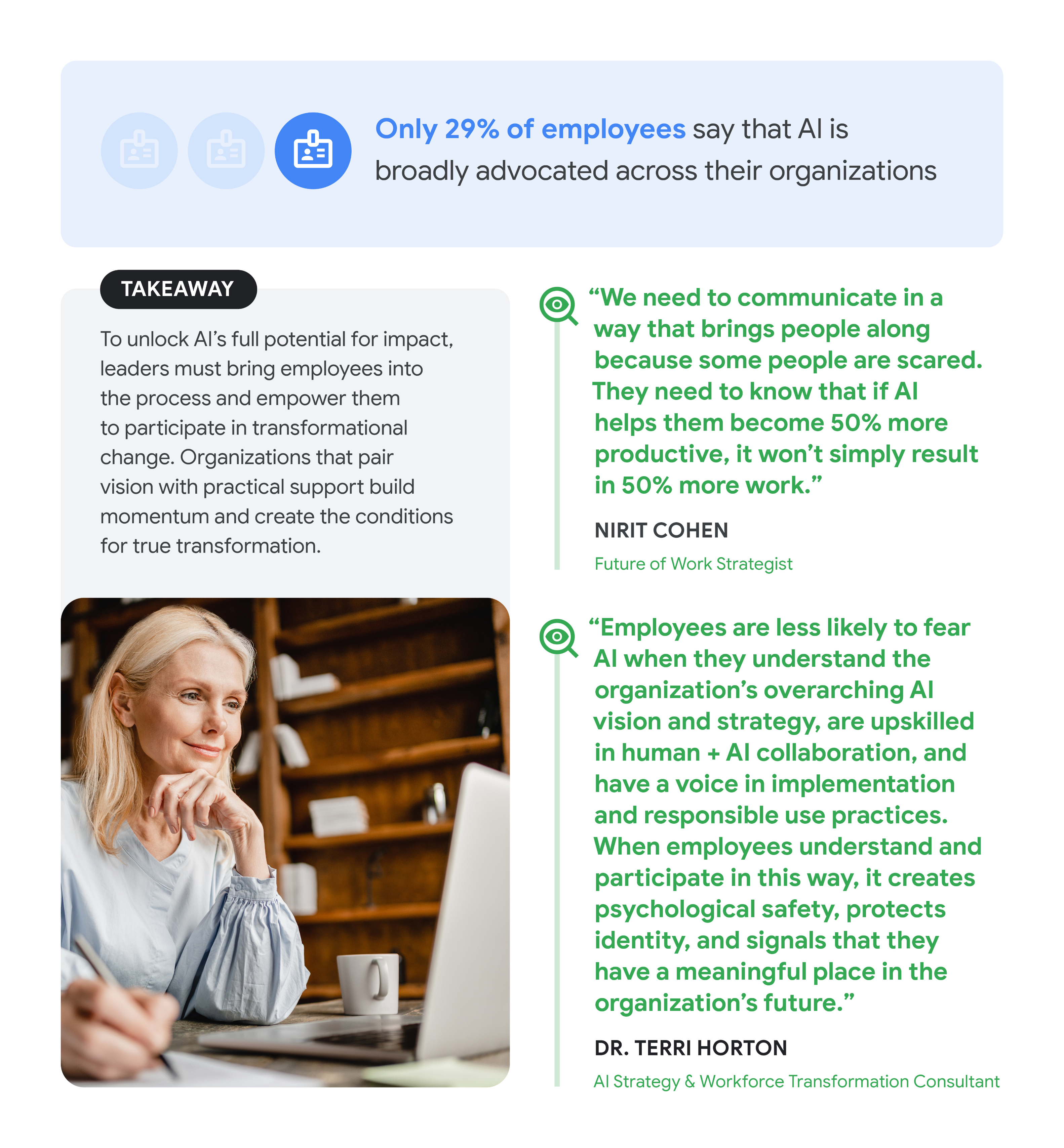
The image is a page from a report discussing the need for leadership to involve employees in AI transformation. A statistic at the top notes: **Only 29% of employees say that AI is broadly advocated across their organizations.** The **TAKEAWAY** section states that to unlock AI's full potential, leaders must bring employees into the process and empower them to participate in transformational change. Organizations that pair vision with practical support can build momentum and create conditions for true transformation. Two quotes are featured: 1. **Nirit Cohen, Future of Work Strategist:** "We need to communicate in a way that brings people along because some people are scared. They need to know that if AI helps them become 50% more productive, it won't simply result in 50% more work." 2. **Dr. Terri Horton, AI Strategy & Workforce Transformation Consultant:** "Employees are less likely to fear AI when they understand the organization's overarching AI vision and strategy, are upskilled in human + AI collaboration, and have a voice in implementation and responsible use practices. When employees understand and participate in this way, it creates psychological safety, protects identity, and signals that they have a meaningful place in the organization's future." A photograph at the bottom left shows a woman with blonde hair, smiling slightly and resting her chin on her hand, while looking down at a laptop and holding a pen over a notebook.

Meet the fully transformed

We looked at companies with higher levels of transformation versus those in initial stages. What can we learn from the 3% who have truly transformed?

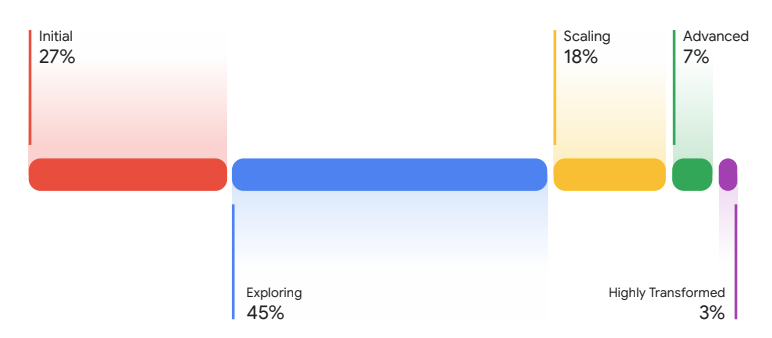
The image is a page from a report titled "Meet the Fully Transformed," which analyzes the five levels of AI transformation across companies, defining the progression based on the number of AI use cases and departments utilizing AI. A horizontal bar chart illustrates the distribution of companies across these five levels: * **Initial:** 27% (Red bar) * **Exploring:** 45% (Blue bar) * **Scaling:** 18% (Yellow bar) * **Advanced:** 7% (Green bar) * **Highly Transformed:** 3% (Purple bar) The accompanying text explains that clear patterns emerge in the breadth and depth of AI use that separate transformed organizations from those just starting, and that these levels reflect an AI maturity index.
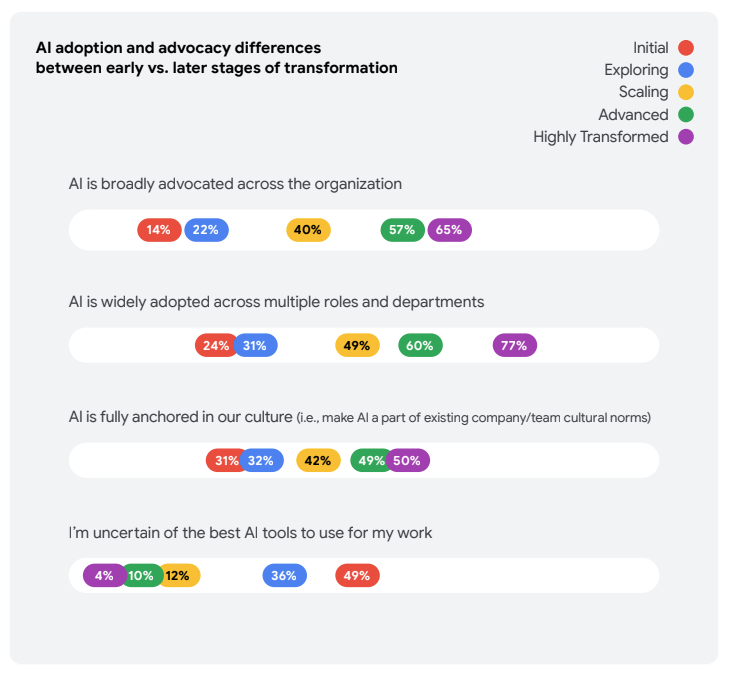
The image is a page from a report illustrating AI adoption and advocacy differences across five stages of transformation: Initial, Exploring, Scaling, Advanced, and Highly Transformed. The text at the top notes that nearly three-quarters of organizations are in the early stages, focusing on adoption, advocacy, anchoring AI in culture, and tool selection, while organizations at the top of the transformation ladder offer best practices. A stacked bar chart details agreement percentages for four statements across the transformation stages: 1. **AI is broadly advocated across the organization:** Agreement rises steadily from 14% (Initial) to 65% (Highly Transformed). 2. **AI is widely adopted across multiple roles and departments:** Agreement increases from 24% (Initial) to 77% (Highly Transformed). 3. **AI is fully anchored in our culture (i.e., make AI a part of existing company/team cultural norms):** Agreement ranges from 31% (Initial) to 50% (Highly Transformed). 4. **I'm uncertain of the best AI tools to use for my work:** This uncertainty starts low (4% Initial) but increases significantly as organizations mature, peaking at 49% for Highly Transformed organizations.
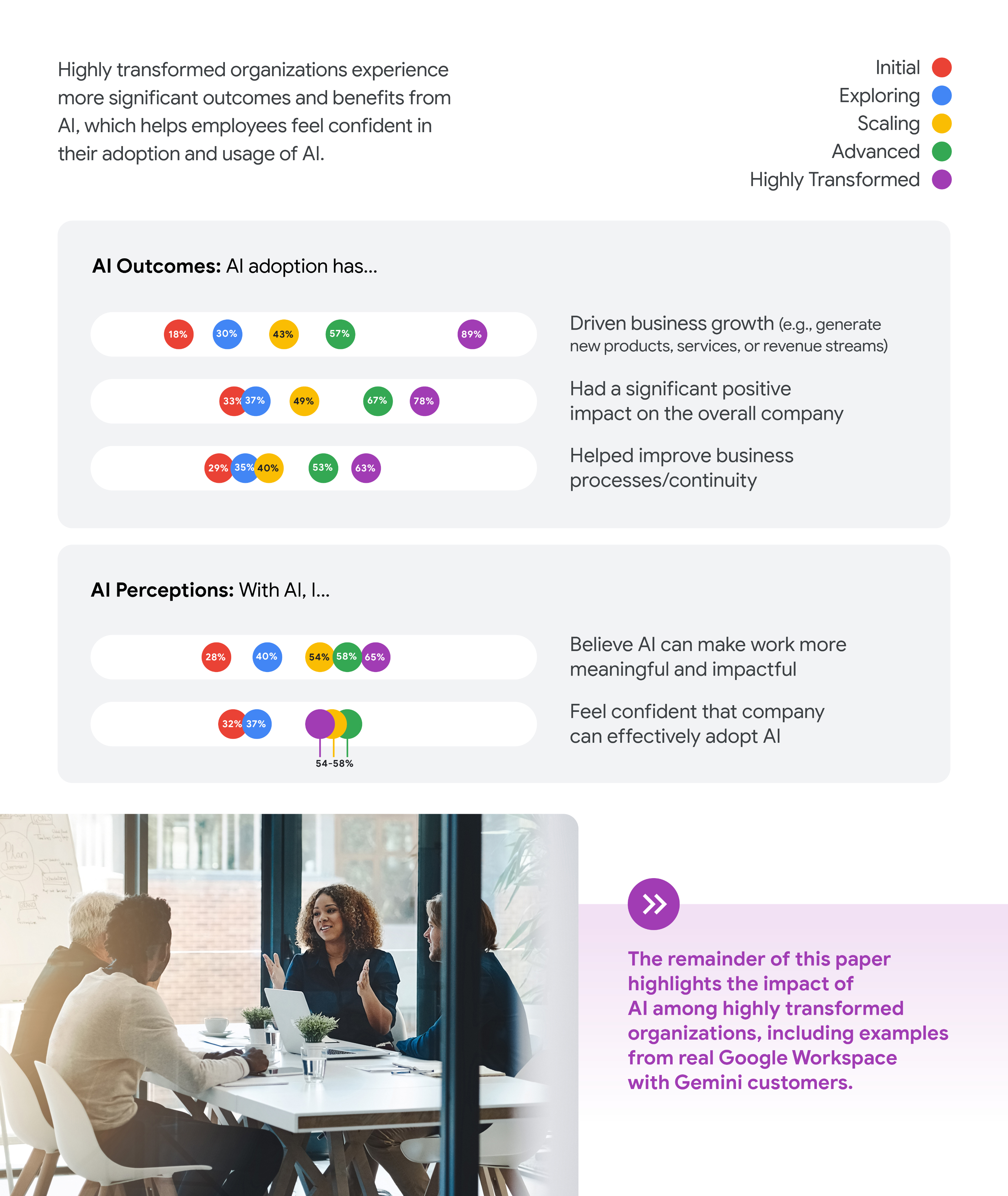
The image is a page from a report titled "Beyond\_AI\_Optimism\_Dec\_2025\_11.jpg," illustrating how highly transformed organizations experience more significant AI outcomes and employee benefits. The first section, **AI Outcomes: AI adoption has...**, compares the percentage of agreement across five transformation stages (Initial, Exploring, Scaling, Advanced, Highly Transformed) for three statements: - **Driven business growth (e.g., generate new products, services, or revenue streams):** Agreement rises steeply from 18% (Initial) to 89% (Highly Transformed). - **Had a significant positive impact on the overall company:** Agreement rises from 35% (Initial) to 78% (Highly Transformed). - **Helped improve business processes/continuity:** Agreement rises from 39% (Initial) to 63% (Highly Transformed). The second section, **AI Perceptions: With AI, I...**, compares perceptions across the five stages for two statements: - **Believe AI can make work more meaningful and impactful:** Agreement ranges from 39% (Initial) to 69% (Highly Transformed). - **Feel confident that company can effectively adopt AI:** Agreement shows a less linear progression, ranging from 32% (Initial) to 58% (Highly Transformed). A purple-highlighted box notes that the remainder of the paper will highlight the impact of AI among highly transformed organizations, including examples from Google Workspace with Gemini customers. Below this text is a photograph showing four people sitting around a table in a meeting room, looking at a laptop and documents while collaborating.

From Saving Time to Expanding Potential

Highly transformed organizations are going from saving time to sparking innovation and creativity.

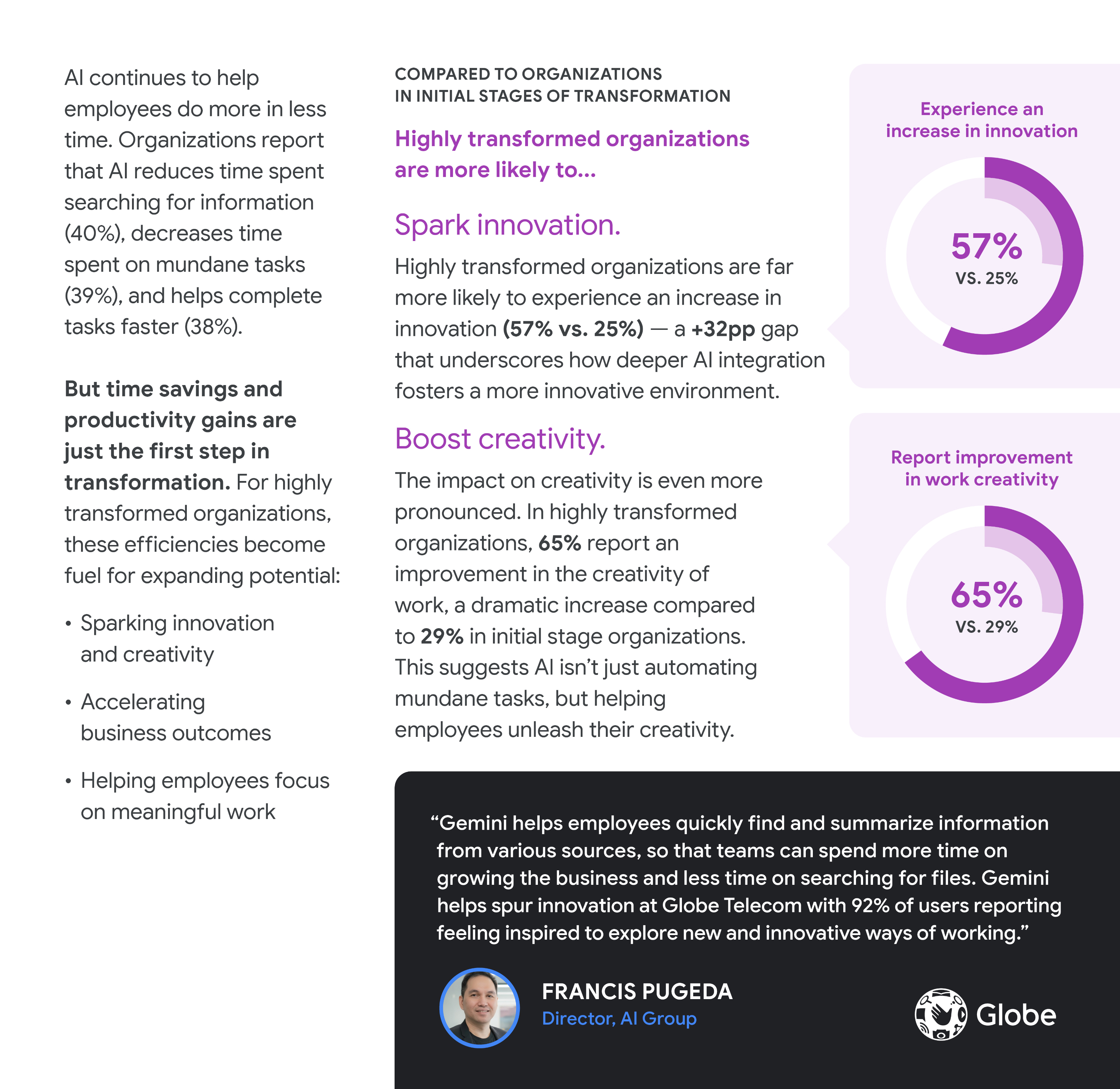
The image is a page from a report titled "From Saving Time to Expanding Potential," which discusses how highly transformed organizations leverage AI beyond basic productivity gains. The text states that AI helps employees reduce time spent searching for information (40%), decrease time spent on mundane tasks (39%), and complete tasks faster (38%). For highly transformed organizations, these efficiencies fuel expansion in potential by: * Sparking innovation and creativity * Accelerating business outcomes * Helping employees focus on meaningful work Compared to organizations in initial stages of transformation, highly transformed organizations are far more likely to: * **Experience an Increase in innovation:** 57% versus 25% (a +32 percentage point gap). * **Report improvement in work creativity:** 65% versus 29%. A quote from Francis Pugeda, Director of the AI Group at Globe, highlights the use of Gemini: "Gemini helps employees quickly find and summarize information from various sources, so that teams can spend more time on growing the business and less time on searching for files. Gemini helps spur innovation at Globe Telecom with 92% of users reporting feeling inspired to explore new and innovative ways of working." The quote is accompanied by a photo of Francis Pugeda.
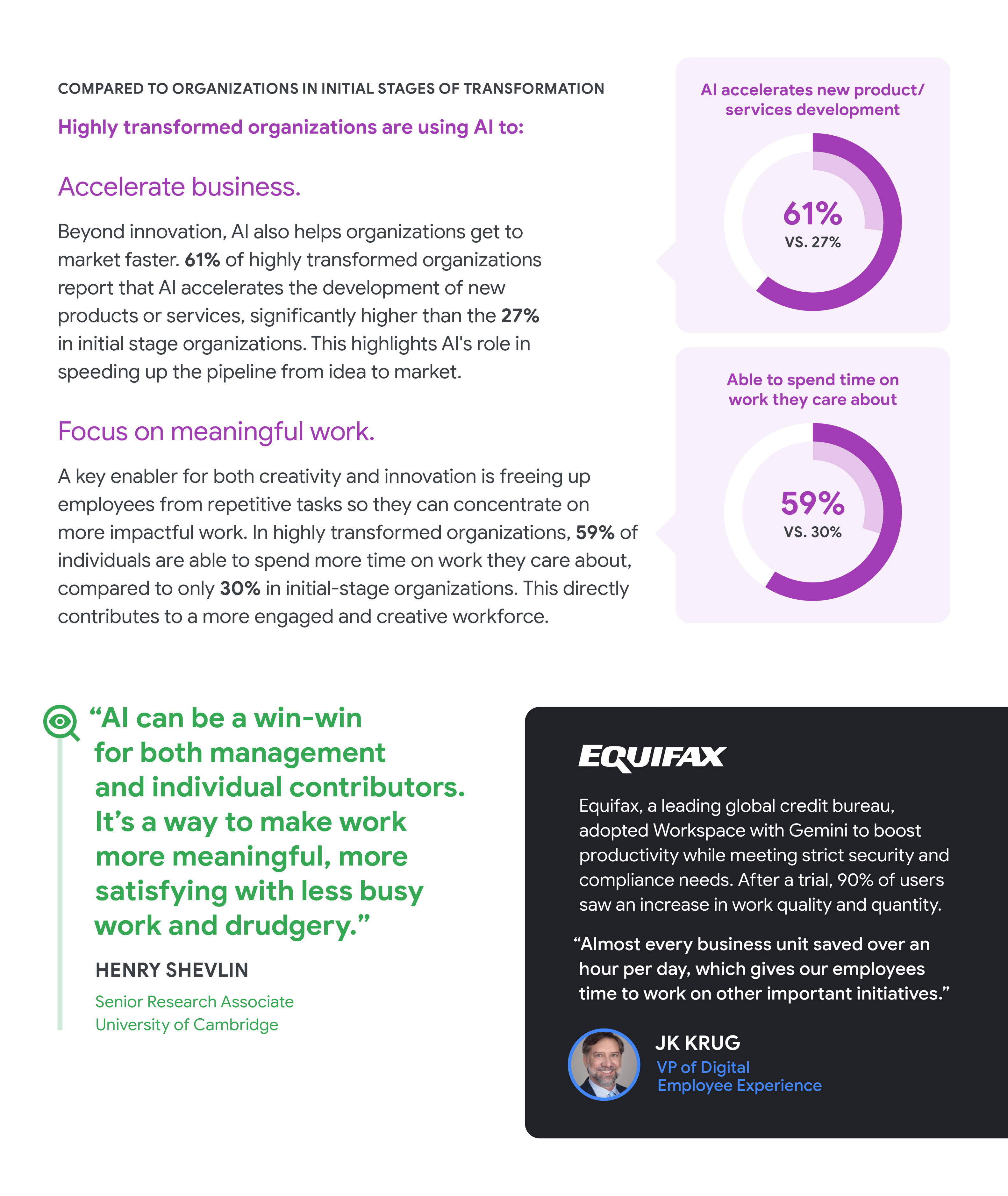
The image is a page from a report detailing how highly transformed organizations leverage AI to accelerate business and focus on meaningful work, compared to organizations in the initial stages of transformation. In terms of accelerating business, a chart shows that **61%** of highly transformed organizations report that AI accelerates the development of new products or services, compared to only **27%** in initial-stage organizations. Regarding focusing on meaningful work, a chart illustrates that **59%** of individuals in highly transformed organizations are able to spend more time on work they care about, compared to **30%** in initial-stage organizations. A quote from Henry Shevlin, Senior Research Associate at the University of Cambridge, states: "AI can be a win-win for both management and individual contributors. It's a way to make work more meaningful, more satisfying with less busy work and drudgery." The document also includes a case study on **Equifax**, a global credit bureau that adopted Workspace with Gemini. After a trial, 90% of users saw an increase in work quality and quantity. JK Krug, VP of Digital Employee Experience at Equifax, is quoted as saying: "Almost every business unit saved over an hour per day, which gives our employees time to work on other important initiatives."
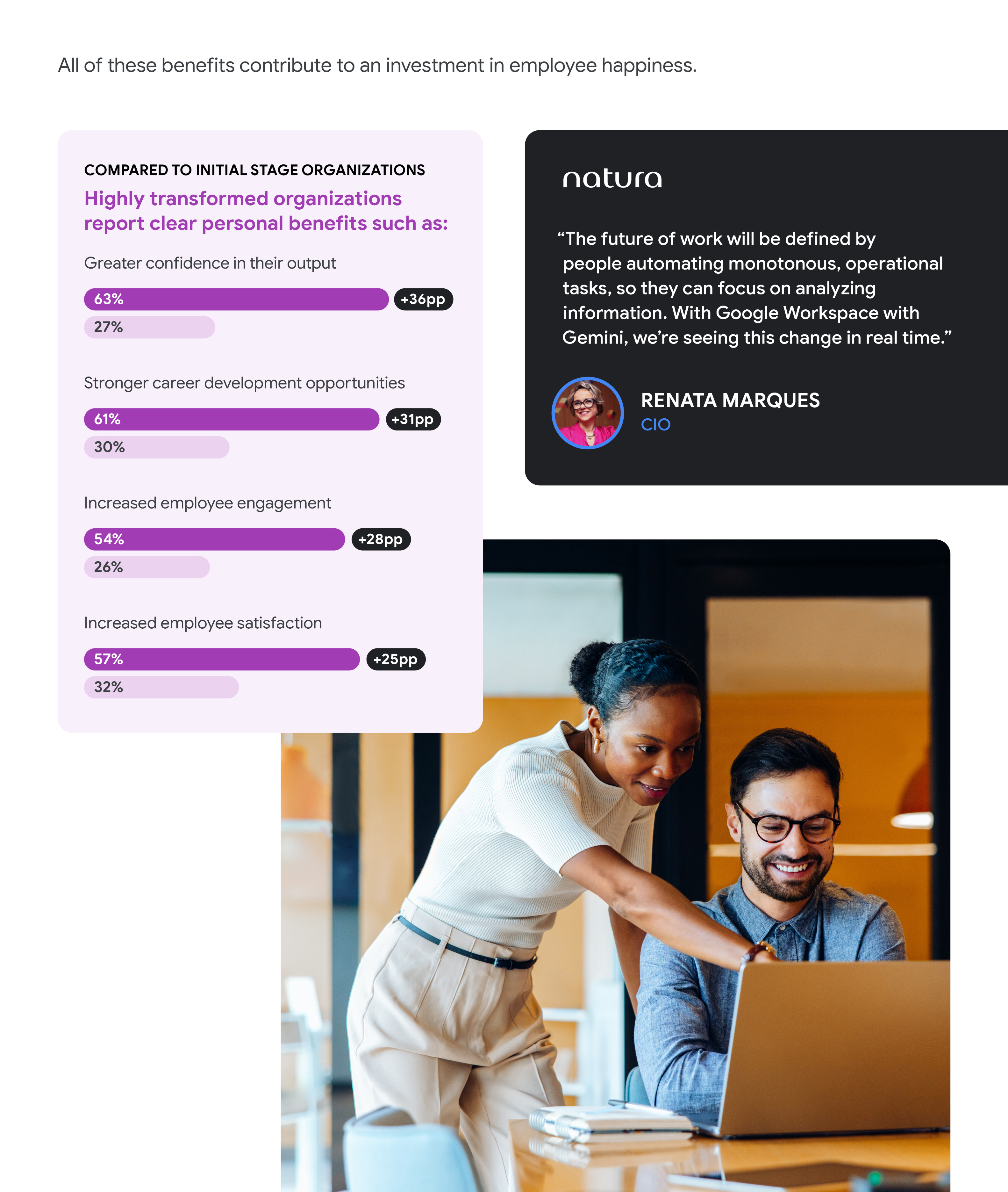
The image is a page from a report discussing how AI benefits employees, leading to an investment in employee happiness. The section **COMPARED TO INITIAL STAGE ORGANIZATIONS** shows that highly transformed organizations report clear personal benefits: - **Greater confidence in their output:** 63% report this, a +36 percentage point difference compared to 27% in initial stage organizations. - **Stronger career development opportunities:** 61% report this, a +31 percentage point difference compared to 30%. - **Increased employee engagement:** 54% report this, a +28 percentage point difference compared to 26%. - **Increased employee satisfaction:** 57% report this, a +25 percentage point difference compared to 32%. A quote from **Renata Marques, CIO at Natura**, states: "The future of work will be defined by people automating monotonous, operational tasks, so they can focus on analyzing information. With Google Workspace with Gemini, we're seeing this change in real time." The quote is accompanied by a photo of Marques. A large photograph at the bottom of the page shows a smiling woman pointing to something on a laptop screen while collaborating with a man who is also smiling and looking at the screen.
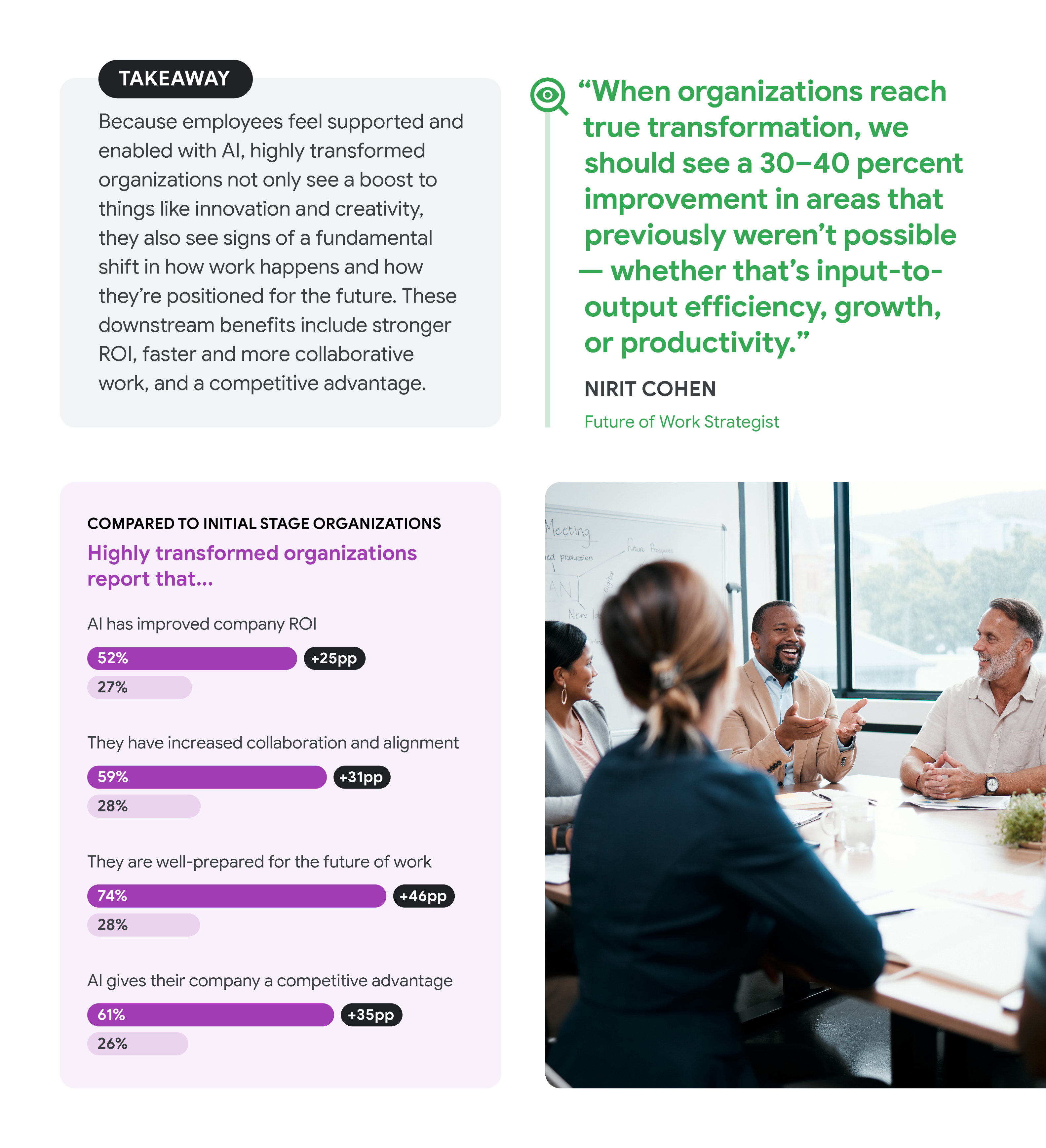
The image is a page from a report discussing the long-term benefits of AI transformation, titled "Beyond\_AI\_Optimism\_Dec\_2025\_15.jpg." The **TAKEAWAY** section explains that because employees feel supported by AI, highly transformed organizations see boosts in innovation and creativity, as well as fundamental shifts leading to stronger ROI, faster and more collaborative work, and a competitive advantage. A quote from **Nirit Cohen, Future of Work Strategist,** states: "When organizations reach true transformation, we should see a 30–40 percent improvement in areas that previously weren't possible — whether that's input-to-output efficiency, growth, or productivity." A chart compares highly transformed organizations to initial-stage organizations on four key downstream metrics: - **AI has improved company ROI:** 52% of highly transformed organizations report this versus 27% of initial-stage organizations (+25 percentage points). - **They have increased collaboration and alignment:** 59% versus 28% (+31 percentage points). - **They are well-prepared for the future of work:** 74% versus 28% (+46 percentage points). - **AI gives their company a competitive advantage:** 61% versus 26% (+35 percentage points). A photograph at the bottom right shows a group of four people around a conference table, with one man speaking animatedly.

Five steps to AI Transformation

Transforming with AI shouldn't be a code only a few elite organizations can crack. Regardless of your AI maturity, adopting these best practices can help accelerate your organization's transformation.

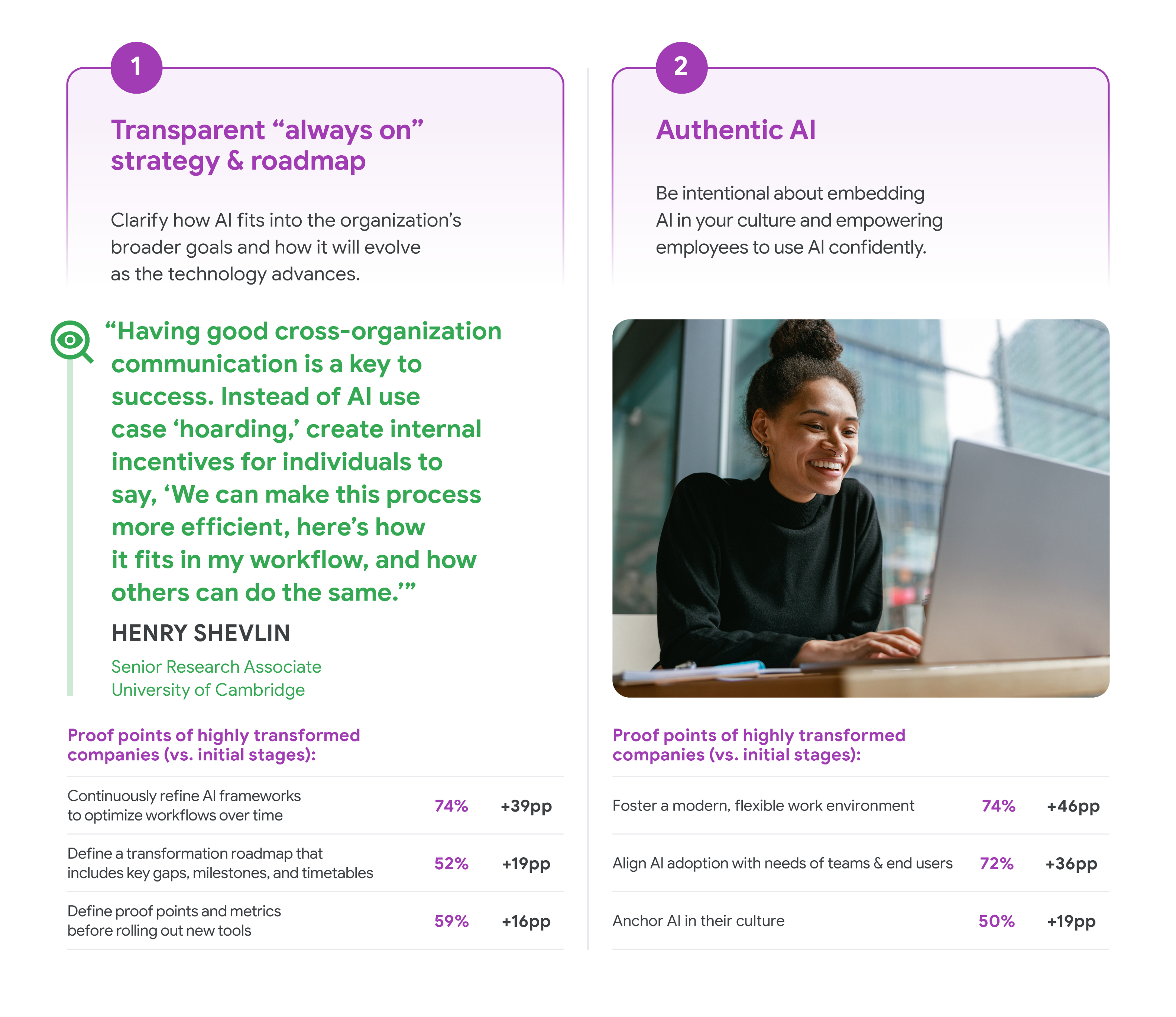
The image outlines the first two of **5 Steps to AI Transformation**, emphasizing that transformation is achievable for all organizations. **Step 1: Transparent "always on" strategy & roadmap** This involves clarifying how AI fits into broader organizational goals and how the strategy will evolve. A quote from **Henry Shevlin, Senior Research Associate at the University of Cambridge**, advises: "Having good cross-organization communication is a key to success. Instead of AI use case 'hoarding,' create internal incentives for individuals to say, 'We can make this process more efficient, here's how it fits in my workflow, and how others can do the same.'" Proof points (comparing highly transformed companies vs. initial stages) show that highly transformed companies are more likely to: * Continuously refine AI frameworks to optimize workflows over time (74%, +39 percentage points). * Define a transformation roadmap that includes key gaps, milestones, and timetables (52%, +19 percentage points). * Define proof points and metrics (59%, +16 percentage points). **Step 2: Authentic AI** This step focuses on embedding AI in the company culture and empowering employees with confidence. Proof points show that highly transformed companies are more likely to: * Foster a modern, flexible work environment (74%, +46 percentage points). * Align AI adoption with the needs of teams & end users before rolling out new tools (72%, +36 percentage points). * Anchor AI in their culture (50%, +19 percentage points). A photograph accompanies Step 2, showing a smiling woman looking at a laptop screen in a modern office setting.
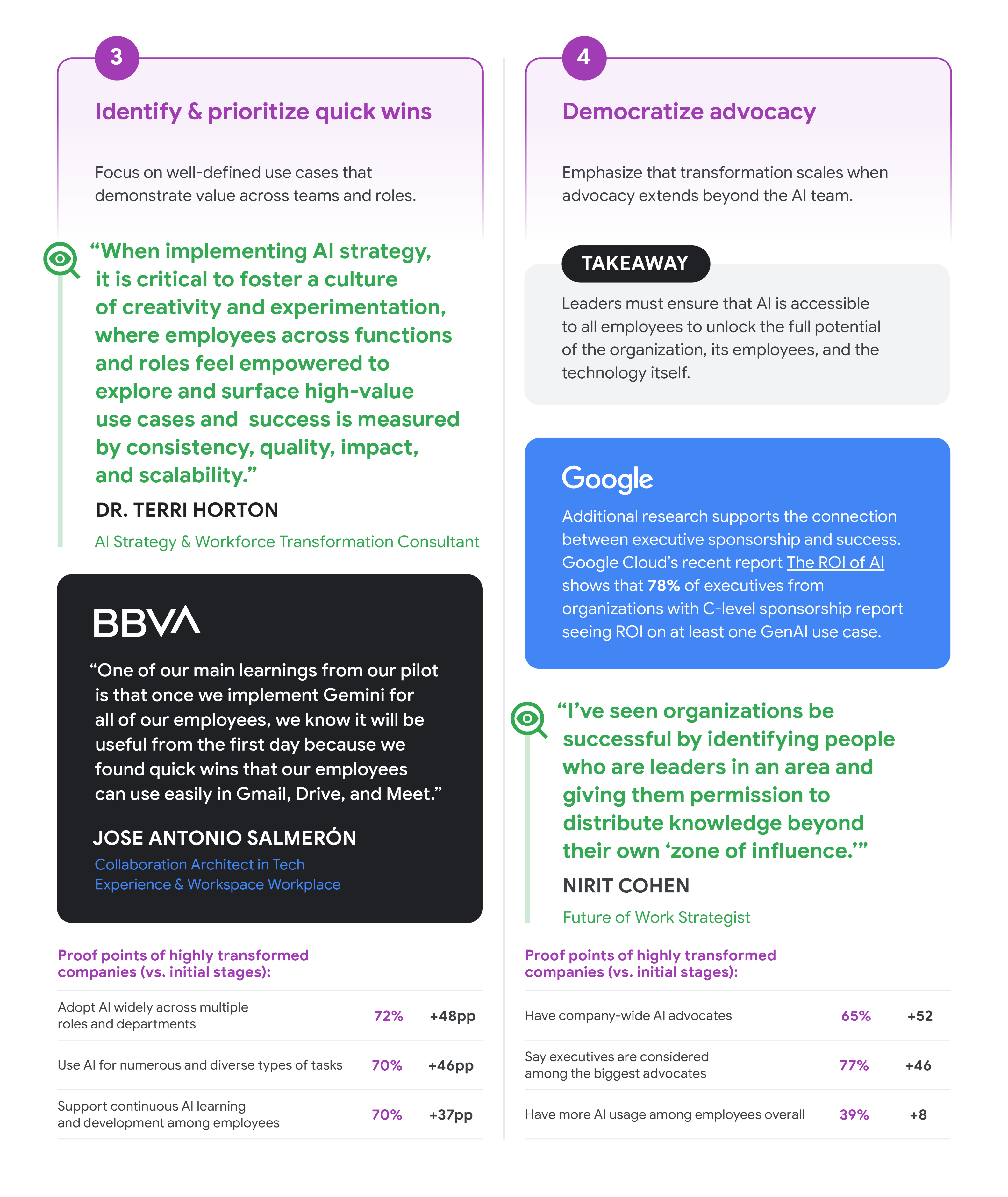
The image outlines the third and fourth steps in the **5 Steps to AI Transformation**. **Step 3: Identify & prioritize quick wins** This step advises focusing on well-defined use cases that demonstrate value across teams and roles. Dr. Terri Horton, AI Strategy & Workforce Transformation Consultant, is quoted: "When implementing AI strategy, it is critical to foster a culture of creativity and experimentation, where employees across functions and roles feel empowered to explore and surface high-value use cases and success is measured by consistency, quality, impact, and scalability." The section includes a case study from **BBVA**, with Collaboration Architect Jose Antonio Salmerón stating that their pilot found quick wins for employees using Gemini easily in Gmail, Drive, and Meet, leading them to believe it will be useful from the first day of full implementation. Proof points comparing highly transformed companies (vs. initial stages) show they are more likely to: * Adopt AI widely across multiple roles and departments (72%, +48pp). * Use AI for numerous and diverse types of tasks (70%, +46pp). * Support continuous AI learning and development among employees (70%, +37pp). **Step 4: Democratize advocacy** This step emphasizes scaling transformation by extending advocacy beyond the AI team. The **TAKEAWAY** is that leaders must ensure AI is accessible to all employees to unlock the full potential of the organization. The section cites **Google**'s report, *The ROI of AI*, showing that 78% of executives from organizations with C-level sponsorship report seeing ROI on at least one GenAI use case. Nirit Cohen, Future of Work Strategist, states she has seen successful organizations that empower area leaders to distribute knowledge beyond their "zone of influence." Proof points comparing highly transformed companies (vs. initial stages) show they are more likely to: * Have company-wide AI advocates (65%, +52pp). * Say executives are considered among the biggest advocates (77%, +46pp). * Have more AI usage among employees overall (39%, +8pp).
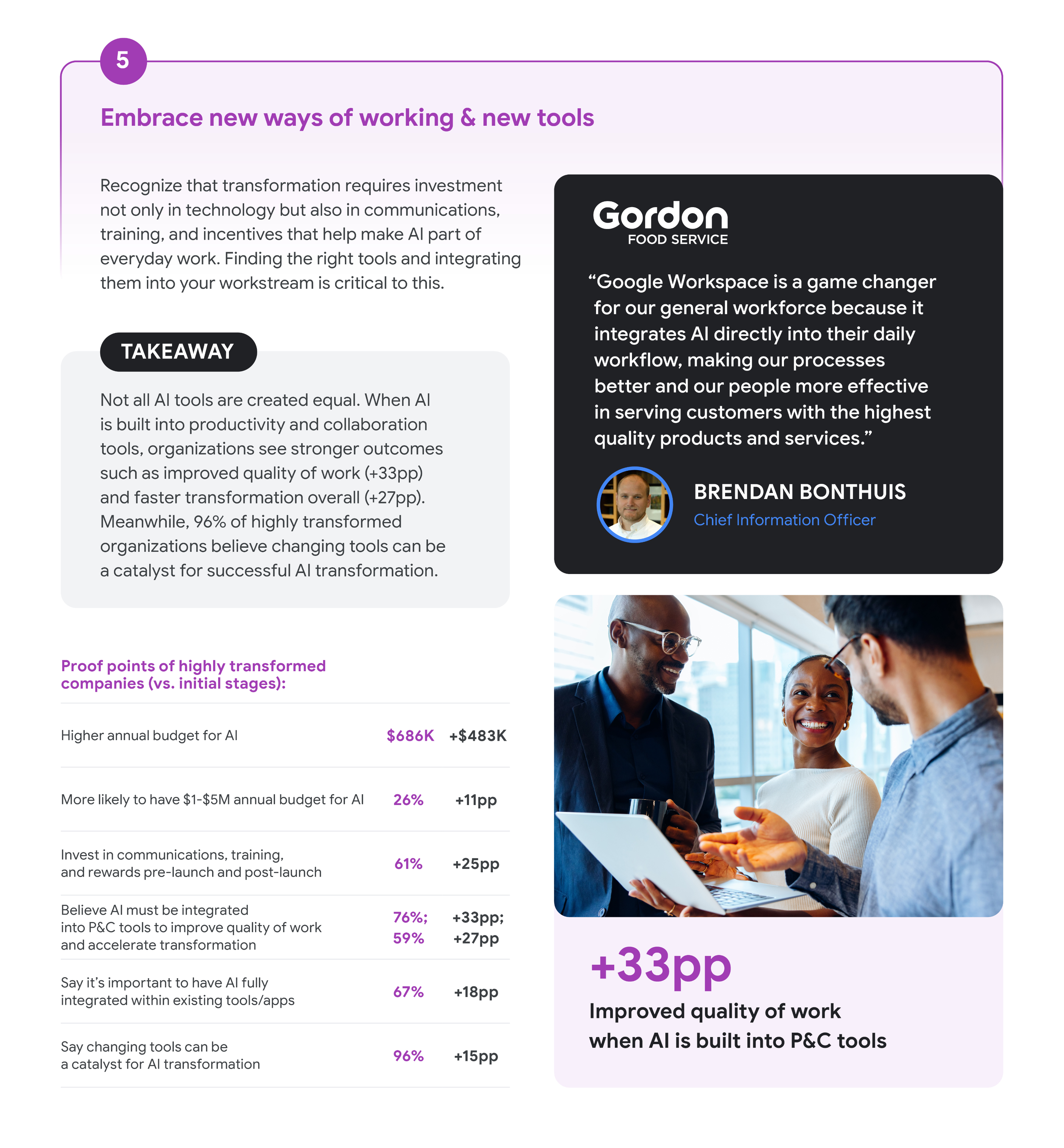
The image outlines the fifth and final step in the AI transformation process: **Embrace new ways of working & new tools.** The text emphasizes that transformation requires investment in technology, communications, training, and incentives to make AI part of everyday work, and that integrating the right tools into the workstream is critical. The **TAKEAWAY** states that not all AI tools are created equal; when AI is built into productivity and collaboration (P\&C) tools, organizations see stronger outcomes, such as improved quality of work (+33 percentage points) and faster transformation overall (+27 percentage points). Furthermore, 96% of highly transformed organizations believe changing tools can be a catalyst for successful AI transformation. A case study features **Gordon Food Service**, with Chief Information Officer Brendan Bonthuis quoted as saying: "Google Workspace is a game changer for our general workforce because it integrates AI directly into their daily workflow, making our processes better and our people more effective in serving customers with the highest quality products and services." A table provides **Proof points of highly transformed companies (vs. initial stages)**: | Metric | Highly Transformed % or Amount | Difference vs. Initial Stages | | :----------------------------------------------------------------------------------------------------- | :----------------------------- | :---------------------------- | | Higher annual budget for AI | $686K | \+$483K | | More likely to have $1–$5M annual budget for AI | 26% | \+11pp | | Invest in communications, training, and rewards pre-launch and post-launch | 61% | \+25pp | | Believe AI must be integrated into P\&C tools to improve quality of work and accelerate transformation | 76%; 59% | \+33pp; +27pp | | Say it's important to have AI fully integrated within existing tools/apps | 67% | \+18pp | | Say changing tools can be a catalyst for AI transformation | 96% | \+15pp | A large graphic at the bottom highlights the finding: **+33pp Improved quality of work when AI is built into P\&C tools.** The image also features a photograph of three people collaborating while looking at a tablet.

Methodology

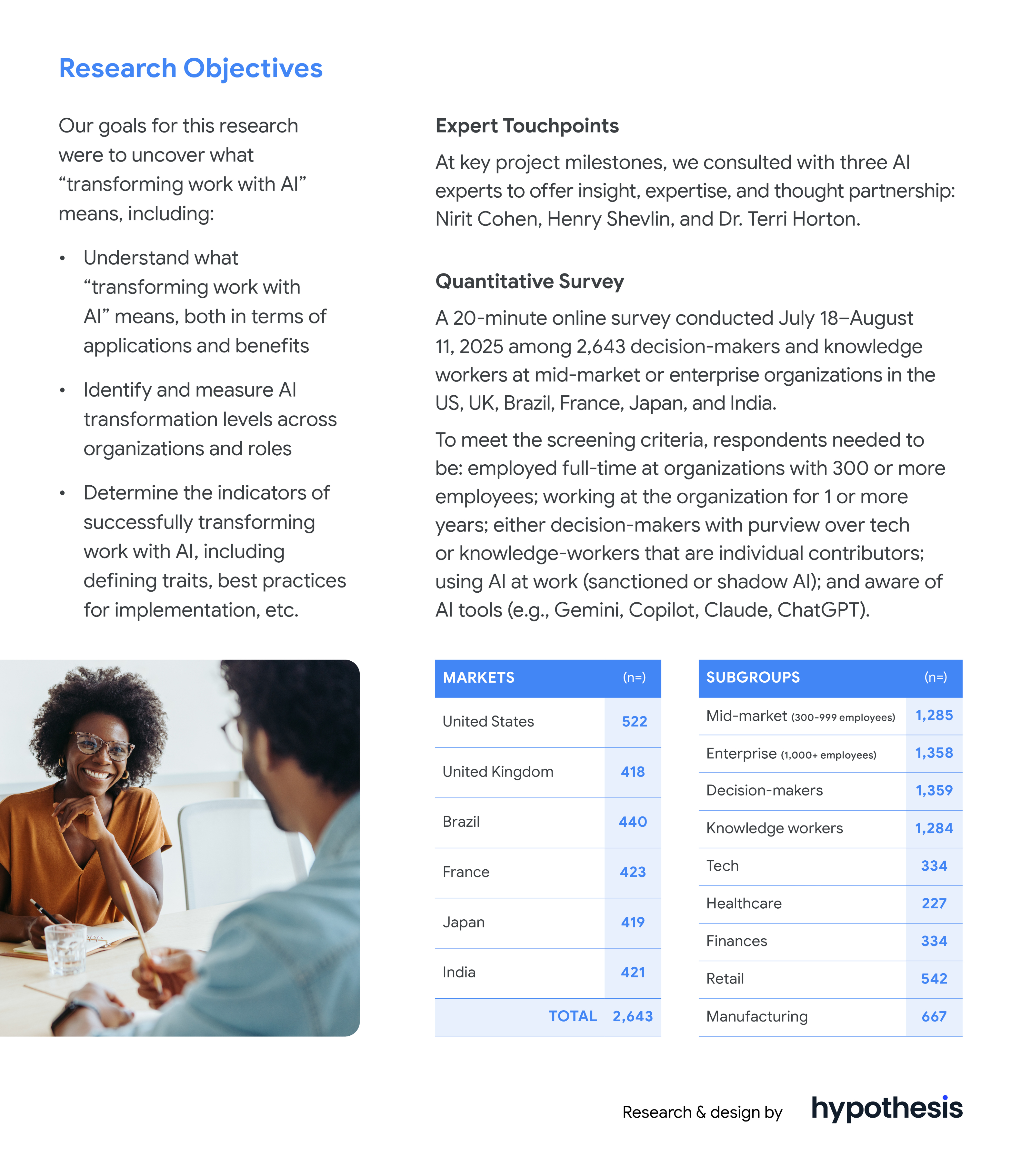
The image is a page from a report detailing the methodology of a research study on AI transformation, titled "Beyond\_AI\_Optimism\_Dec\_2025\_20.jpg." **Research Objectives** are listed as: * Understand what "transforming work with AI" means, both in terms of applications and benefits. * Identify and measure AI transformation levels across organizations and roles. * Determine the indicators of successfully transforming work with AI, including defining traits, best practices for implementation, etc. The study included **Expert Touchpoints** with three AI experts: Nirit Cohen, Henry Shevlin, and Dr. Terri Horton. The **Quantitative Survey** was a 20-minute online survey conducted from July 18 to August 11, 2025, among 2,643 decision-makers and knowledge workers at mid-market or enterprise organizations in the US, UK, Brazil, France, Japan, and India. Respondents were required to be: full-time employees at organizations with 300 or more employees; employed for 1 or more years; decision-makers or knowledge-workers with tech purview; using AI at work (sanctioned or shadow AI); and aware of AI tools (e.g., Gemini, Copilot, Claude, ChatGPT). Data tables provide the sample breakdown: | MARKETS | (n) | | :------------: | :---: | | United States | 522 | | United Kingdom | 418 | | Brazil | 440 | | France | 423 | | Japan | 419 | | India | 421 | | TOTAL | 2,643 | | SUBGROUPS | (n) | | :----------------------------: | :---: | | Mid-market (300-999 employees) | 1,285 | | Enterprise (1,000+ employees) | 1,358 | | Decision-makers | 1,359 | | Knowledge workers | 1,284 | | Tech | 334 | | Healthcare | 227 | | Finances | 334 | | Retail | 542 | | Manufacturing | 667 | The research and design were conducted by Hypothesis Group. The image also includes a photograph of a woman smiling while looking at a laptop and holding her chin.