The power — and the paradox — of enterprise context in AI

Pat McCarthy
VP of Google Workspace Sales
Try Google Workspace at No Cost
Get a business email, all the storage you need, video conferencing, and more.
SIGN UPLet’s be unequivocal: enterprise context is a cornerstone of effective AI adoption and output.
To drive genuine business value, AI agents must understand your organization’s reality. They need access to your client engagement patterns, operational data, communication cadence, security parameters, and institutional knowledge to be effective. With deep enterprise context, AI can become an indispensable partner for all lines of business in your organization.
However, as our tools get exponentially better at ingesting institutional memory, a critical nuance appears: more context is not always better for every situation.
Understanding when context empowers us and when it constrains us is the next major shift in AI literacy.
Avoiding the trap of contextual homogeneity
When an AI agent is anchored entirely in historical enterprise artifacts, it can be guided to optimize for what has worked, not what could work. That can be useful in operationalizing processes or projects that have been successful.
But if you rely on internal context to too great a degree, you risk hardcoding confirmation bias and reality bias directly into the output. This risks trapping teams in a cycle of:
- Contextual tunnel vision: Solving new market problems using yesterday’s institutional frameworks.
- Over-fitting: Producing outputs that mimic existing internal documents so closely that they inherit all the historical blind spots.
- Contextual homogeneity: Every strategic proposal begins to sound like the same committee wrote it.
As Marshall Goldsmith famously said: "What got you here, won't get you there." If your AI only knows your organization's past, its recommendations will always defend your organization's status quo.
Making the shift: selective grounding vs. intentful context exclusion
The next competitive frontier in enterprise AI is not maximum ingestion — it is discernment. Leaders must build an intentional framework around two distinct modes of inquiry:
- Selective grounding (execution mode): When precision, compliance, operational continuity, and institutional consistency are the primary goals.
- Intentful context exclusion (discovery mode): When you actively strip away corporate constraints to invite external diversity of thought, cross-industry perspectives, and unconstrained problem-solving.
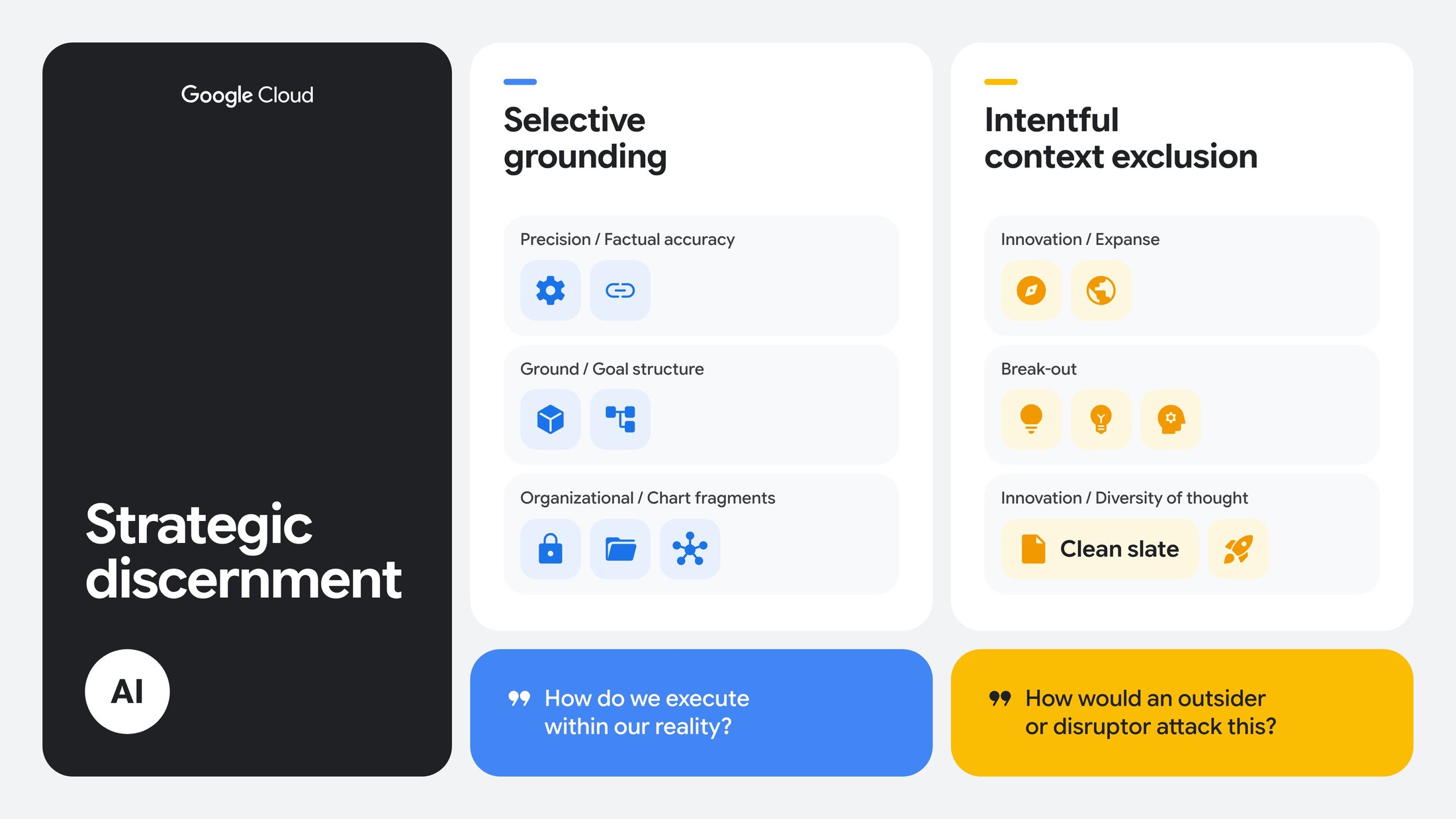
Deciding when to use selective grounding vs. excluding content in enterprise AI usage.
Understanding the output in action: context vs. clean slate
To see the difference in practice, look at how identical prompts behave when we toggle enterprise grounding on versus off:
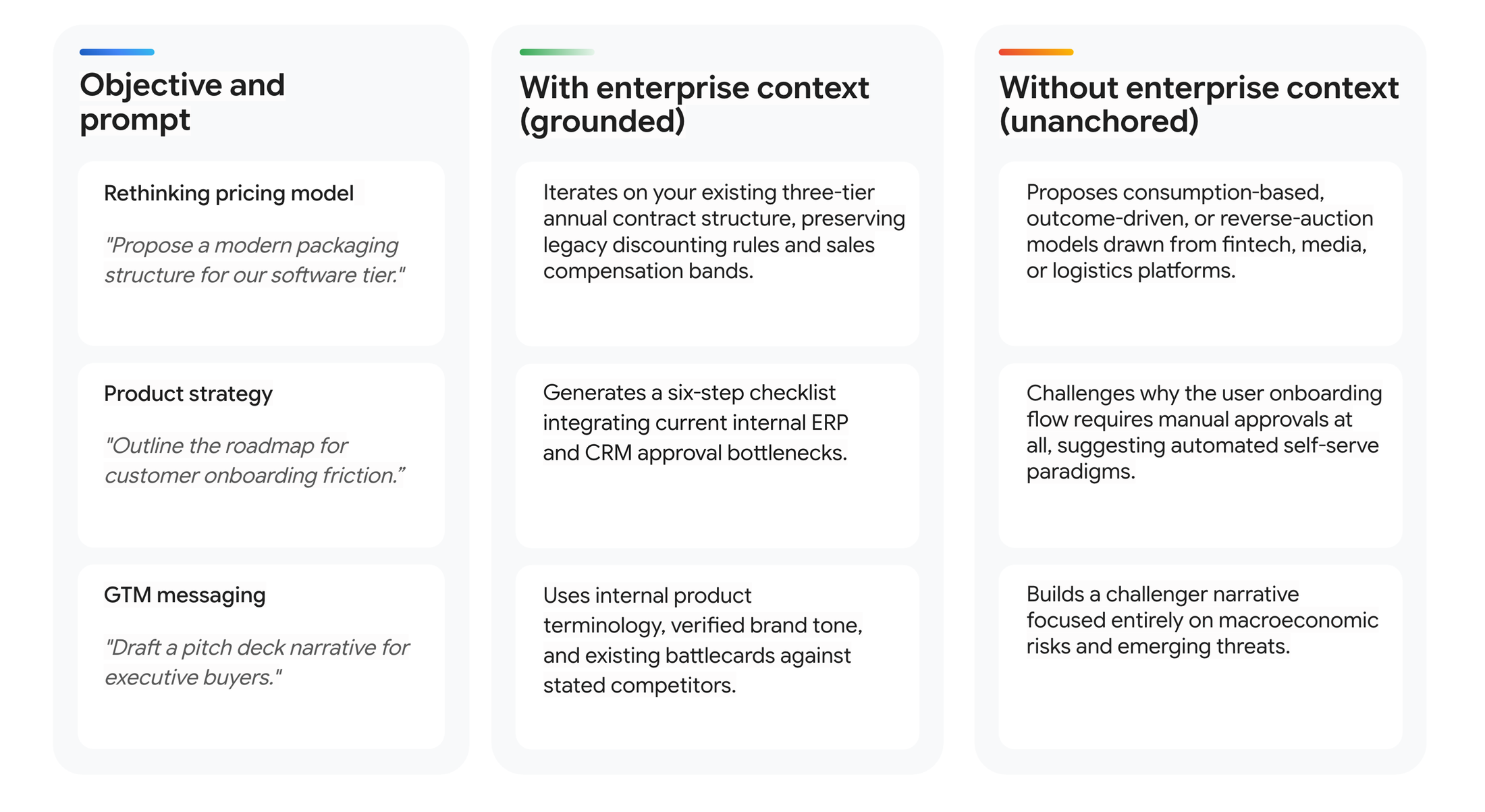
Neither output is inherently better than the other; there is simply a time and a place for both, and teams should intentionally consider which approach serves their goal up front.
Turning enterprise context on and off with Gemini
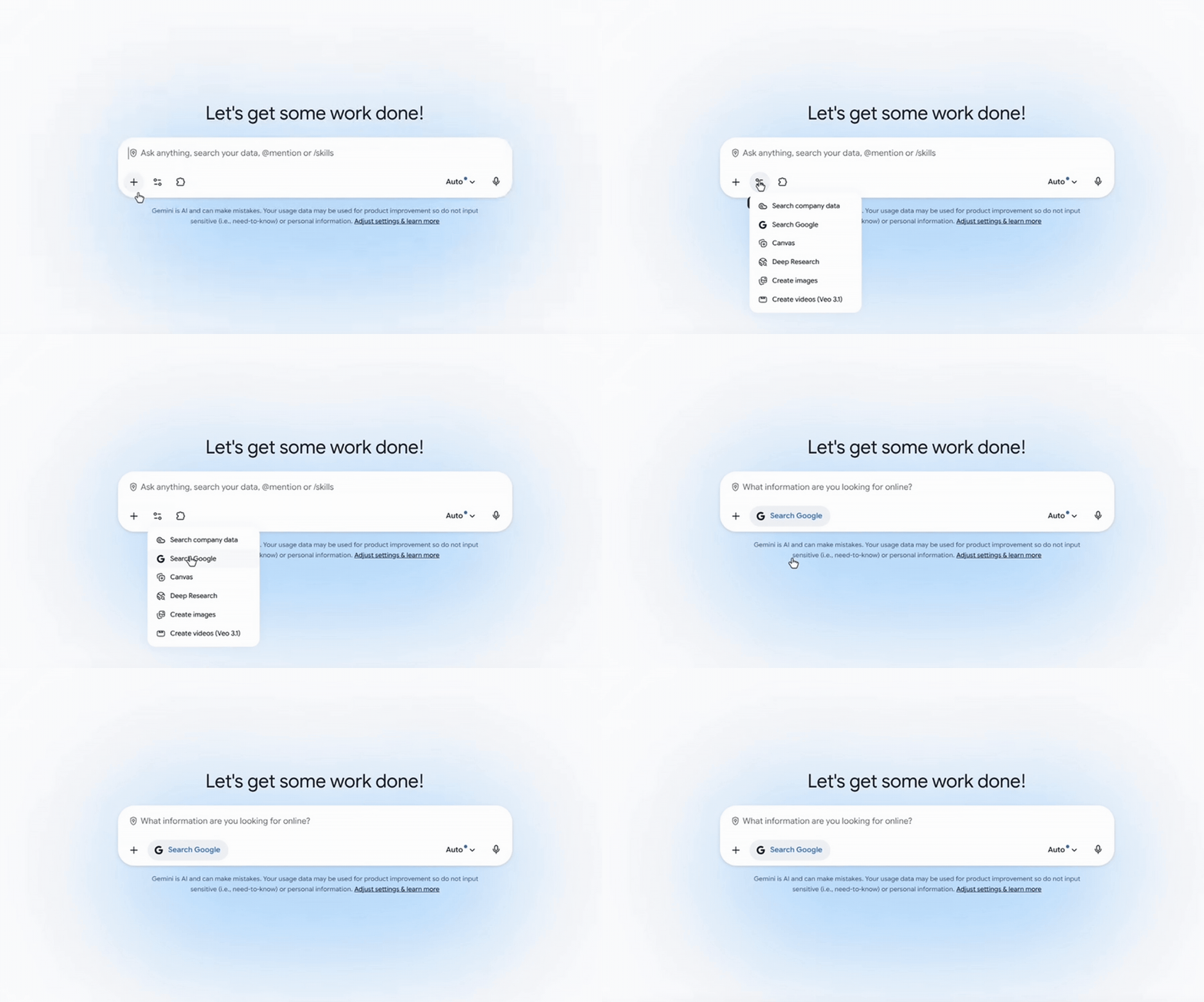
If you’re already using Gemini, there are a few options to turn enterprise context on and off easily.
- In Google Docs, Google Drive, and Gmail, you can toggle “Where Gemini Can Search” off and on to see how outputs vary.

2. Type into the side panel in any of your Workspace tools, either: “Ignore internal documentation” for enterprise grounding or “Use external sources only” to remove enterprise context.

3. In Gemini, toggle on or off “Search Company Data” vs. “Search Google in Gemini” to add enterprise context or not.
Leading through the paradigm shift
Knowing when to anchor and when to unanchor is important.
When your team is drafting an RFP response or updating quarterly operational forecasts, anchor deeply. You need factual accuracy, compliance, and institutional memory.
However, when you are designing a new business model, launching a turnaround strategy, or diagnosing why a product is losing share, explore by intentionally excluding the context. Prompt the model as if your company does not exist. Let it pull from the widest possible aperture of global knowledge, diverse industries, and counterintuitive logic.
AI shouldn't just be an echo chamber for your corporate past — it should be a catalyst for your exponential future.