Google named a Leader in IDC Marketscape: Worldwide Intelligent Content Services 2026 Vendor Assessment

David Wurtz
Sr Director, Product Management, Google Workspace
Try Google Workspace at No Cost
Get a business email, all the storage you need, video conferencing, and more.
SIGN UPWe’re thrilled to share that Google has been named a Leader in the September 2026 IDC MarketScape: Worldwide Intelligent Content Services 2026 Vendor Assessment (see details below). The report evaluates 17 intelligent content services providers across 25 comprehensive criteria.
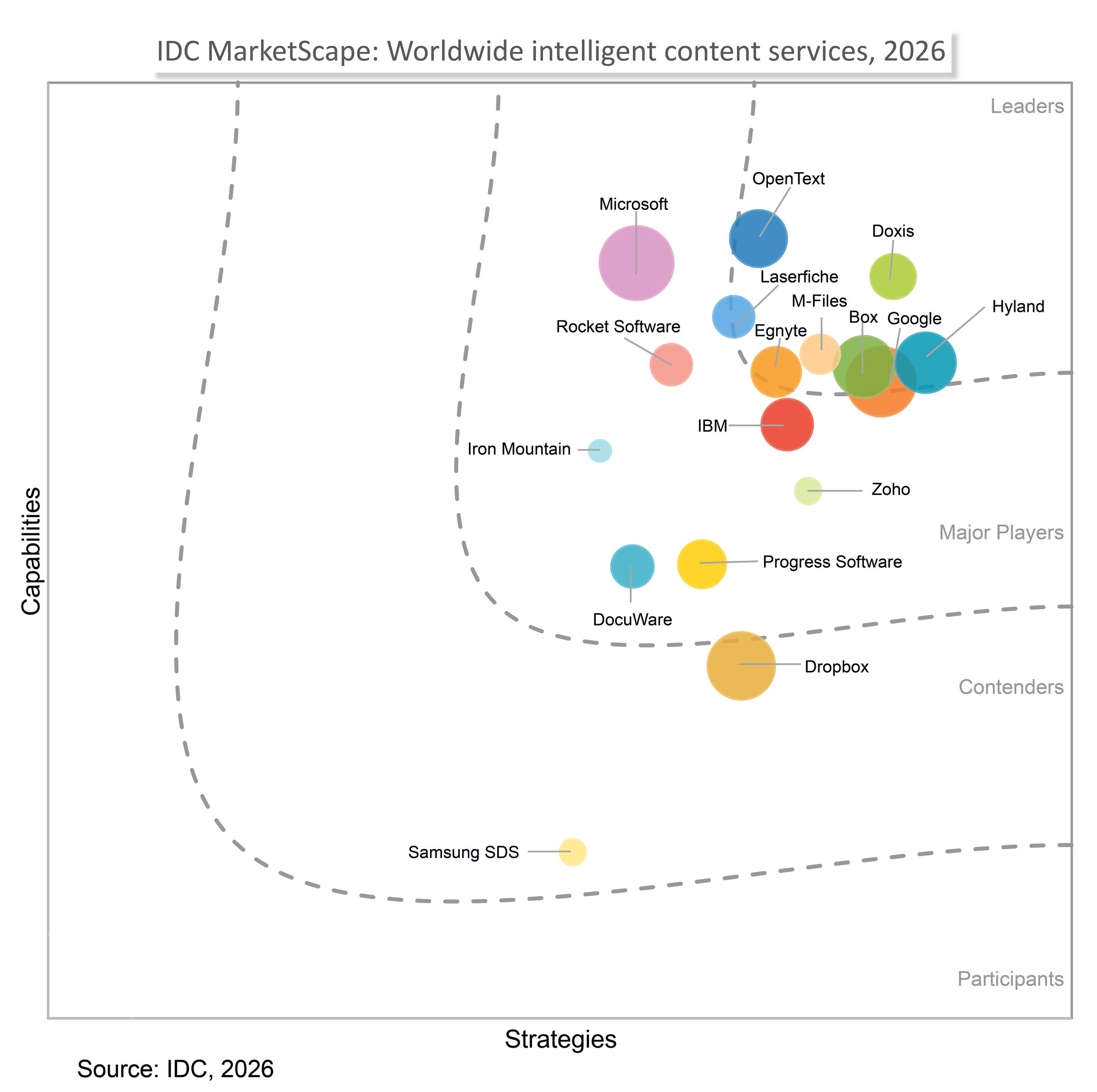
“IDC MarketScape: Worldwide Intelligent Content Services 2026 Vendor Assessment”, September 2026, IDC #US54137426. Full details at the bottom of the post.
We believe our Leader position reflects a meaningful evolution in content management — moving from passive storage to active intelligence. This shift is seen in Workspace Intelligence, which delivers personalized assistance across Google Workspace — right where your work already happens. Of course, intelligence is nothing without trust. That is why our platform is backed by proactive threat defense and uncompromising data security and sovereignty controls. And for organizations currently using Microsoft 365, we’ve simplified the move to Google Workspace with new migration and interoperability features.
The IDC MarketScape notes, “Organizations of any size should consider Google's broad portfolio of content capabilities and services to process, understand, analyze, and store content for a broad range of use cases. Google Cloud is the foundation of Workspace and Drive, and investment in cutting-edge and applied technology research enables Google to be at the forefront of applying AI and agentic AI to content services. The architecture for supporting agentic AI is built on a unified stack that integrates creation, execution (with a contextual foundation and native knowledge graph capabilities), and monitoring. Google's scalability and pace of innovation remain noteworthy, and its customers and partners look to the provider to utilize a technology-first approach to expand collaboration.”
The IDC MarketScape highlighted Google’s strengths in:
- Productivity and collaboration: Google Workspace's unified, cloud-native architecture reduces friction, version-control issues, and context-switching common to legacy, disconnected productivity ecosystems. Gemini builds on this foundation, combining Google's training on information from Search with business context drawn from across Workspace.
- Security and data sovereignty: Google offers native end-to-end client-side encryption (CSE) paired with a customer-managed key service, ensuring that even Google's native file types remain unreadable to the cloud provider under all circumstances, including government data requests or internal access. This zero-trust foundation extends protection against insider risk, compromised credentials, and unauthorized third-party access, while giving customers direct control over encryption keys, data residency, and regulatory compliance. Because encryption operates at the client level rather than relying solely on provider-managed infrastructure, organizations retain full sovereignty over sensitive content without sacrificing the collaborative functionality of native Workspace applications.
- Context-aware intelligence: Gemini's AI-powered search and assistant capabilities use semantic search to synthesize and ground answers in a user's specific files, emails, and chats. Gemini employs the relationships between a user's emails, chats, and documents in real time to synthesize answers. Users can reference specific files directly in prompts, or use Drive Projects to bundle files, emails, and other sources into a curated knowledge base, giving teams a defined boundary of "truth" so outputs stay anchored in relevant, approved context. Inline citations let users evaluate generated content directly, distinguishing corroborated statements from those needing further scrutiny and reducing the risk of undetected hallucinations.
Get started
Download the complimentary IDC MarketScape: Worldwide Intelligent Content Services 2026 Vendor Assessment excerpt to learn why organizations are choosing Google Workspace.
IDC MarketScape vendor analysis model is designed to provide an overview of the competitive fitness of technology and service suppliers in a given market. The research methodology utilizes a rigorous scoring methodology based on both qualitative and quantitative criteria that results in a single graphical illustration of each vendor’s position within a given market. The Capabilities score measures vendor product, go-to-market and business execution in the short-term. The Strategy score measures alignment of vendor strategies with customer requirements in a 3-5-year timeframe. Vendor market share is represented by the size of the circles. Vendor year-over-year growth rate relative to the given market is indicated by a plus, neutral or minus next to the vendor name.