Which quadrant are you in? Navigating the human side of agentic transformation

Pat McCarthy
VP of Google Workspace Sales
Try Google Workspace at No Cost
Get a business email, all the storage you need, video conferencing, and more.
SIGN UPI spend a lot of my time on airplanes, traveling across the globe to meet with leaders of all different backgrounds and perspectives — from founders of hyper-growth startups in Bengaluru to seasoned executives of industrial enterprises in Europe and North America. In these conversations, I’ve realized something fundamental: when it comes to technology and digital transformation, no two leaders, or even two employees, look at change the same way.
In some offices, I’m met with pure, unbridled excitement about how generative AI can move from the sandbox to core business workflows. In others, I sit across the table from leaders whose primary mandate is to protect the company, asking cautious, pragmatic questions about security and data governance. These conversations aren't just about software; they are about people and how they approach and feel about undertaking change.
And successfully driving change, especially when it involves hundreds and thousands of people and entrenched tools and systems, represents a massive opportunity for businesses.
How to define success in agentic AI transformation
Most organizations are so committed to their legacy license ecosystem that they’ve stopped asking if the software actually drives growth. They are paying a status quo tax disguised as an IT budget. We have to define success not by the technology itself, but by real business impact, asking and answering questions like: Are your new product release cycles fast enough? Is customer satisfaction trending in the right direction? Is your team thriving?
For organizations to make the agentic pivot, they need to bring everyone along on the journey. To help make sense of how people react to change, we use a simple 2x2 matrix (inspired by Mendelow, 1981; adapted by Johnson and Scholes, 1993) in our work with customers. On the vertical axis, we plot decision-making authority — from the C-suite to frontline execution. On the horizontal axis is the willingness to change — from eager early adopters to cautious, risk-averse stakeholders.
When you map these out, you find four distinct personas. Let’s break them down:
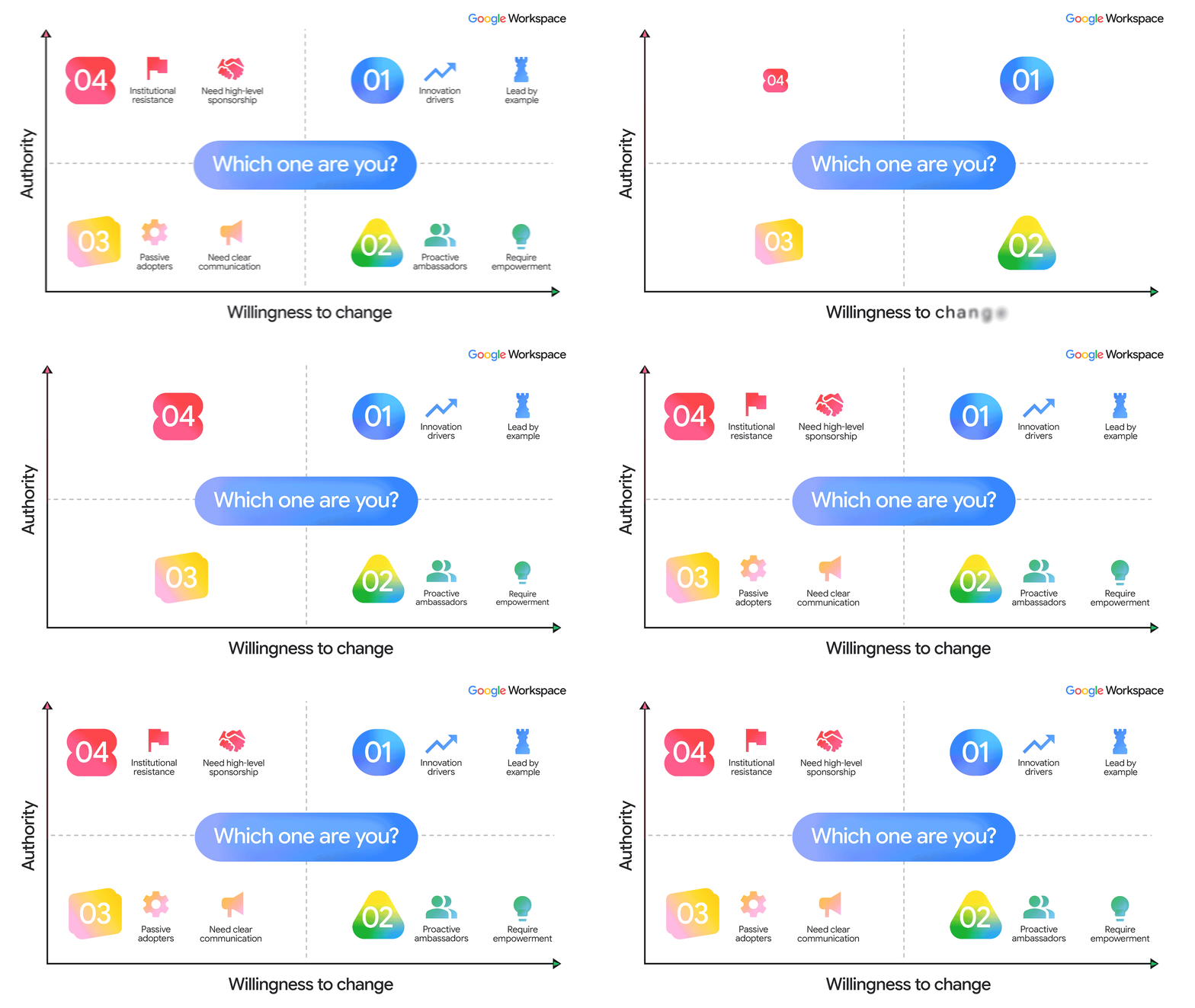
1. The Innovation Drivers (high authority, high willingness)
These are your changemaking executives — the CEOs, CTOs, and CIOs who see the big picture. They understand that adopting advanced capabilities like Gemini isn't a nice to have but a critical competitive advantage. They have the budget and the mandate, but they rely on their teams to build the actual strategy. For these leaders, the key is to lead by example. They must be visible role models, demonstrating their personal commitment to the tools they expect others to use.
2. The Proactive Ambassadors (low authority, high willingness)
These are your ground-level allies, in many cases the first to raise their hands to champion a cause. Even if they weren't in the room when the procurement decisions were made, they are eager to dive in, discover new use cases, and automate their workflows. These ambassadors are the lifeblood of your transformation. They don't need permission to innovate, but they do need empowerment. When you empower them, they provide the peer-to-peer coaching that drives grassroots adoption. Proactive ambassadors are often the first to go out and start testing the latest AI tools. They don't set out to break IT policies — policy violations are just a side effect of official tools failing them. If you don't empower them with governed, enterprise-grade AI, they will build their own workarounds, potentially contributing to your next security breach.
3. The Passive Adopters (low authority, low willingness)
These are your daily execution operators. They are incredibly focused on one thing: getting their day-to-day work done. Naturally, they view any new tool as a potential friction point or disruption to an established, comfortable workflow. For these folks, success comes down to seamless integration. It’s important to provide an intuitive, friction-free experience where the AI eliminates routine distractions and proves its immediate, practical value right where they already work.
4. The Institutional Resistance (high authority, low willingness)
These are key leaders in Legal, Compliance, HR, or Security, whose job is to protect the business. Their caution is necessary — they keep the organization safe from risk. You cannot mandate change to this group. Instead, you need high-level sponsorship and proactive engagement. You must demonstrate early on that the new solution meets their rigorous standards, showing how innovation and security can actually go hand in hand. Compliance and Legal are key partners in business growth and innovation. When you provide them with a platform built on foundational security, they transition from risk managers to the greatest enablers of business agility.
How to get started in your organization
It's likely you can place everyone in your organization into one of these four boxes. If you treat them all the same, your transformation will stall. You have to start from their reality.
So, let me challenge you to take a hard look at your own organization today:
- Where do you sit on this quadrant? Are you pushing the boundaries, or are you quietly holding back?
- Where do your colleagues sit? Are you empowering the ambassadors on your team, or trying to force-feed tools to passive adopters?
- And what about your boss? Are they leading by example, or do you need to help them see the value-led picture?
Ultimately, recognizing where your stakeholders sit on this quadrant is the essential first step toward building an effective change management strategy. By moving beyond just showcasing innovative technology and instead meeting people where they are — appealing to their individual motivations, what they care about fostering, and what they need to protect — you can drive meaningful growth. This transformation cascades from the project and line-of-business levels up to the key business metrics that your board cares about most, turning the opportunity for adoption into a repeatable engine for success.
In this tech cycle, we are really in the first second of a 24-hour day. How we manage this change now will determine who wins the future.