Bridging the gap between AI ambition and readiness: new survey data

Derek Snyder
Director, Workspace Product Marketing
Try Google Workspace at No Cost
Get a business email, all the storage you need, video conferencing, and more.
SIGN UPSo much can happen in a year, and that proves especially true when it comes to the AI maturity curve. I’ve been fortunate to experience AI innovation up close at Google, seeing the promise of AI firsthand through the many transformative customer use cases keeping us inspired.
To help support all of our users in their growth, we survey AI adopters regularly to understand how organizations are actually faring in the trenches and in the boardroom.
Just a year ago, we published “Beyond AI Optimism,” where we asked thousands of global respondents about their use and perception of AI at work. The biggest finding: leaders were significantly more optimistic about AI’s impact than the people doing the work every day.
Recognizing that this critical gap would define the landscape, we focused our research on this topic again this year, publishing our discoveries in the 2026 report: Beyond AI Optimism: Closing the Ambition Gap. We ran an updated version of the survey, capturing trends from last year along with emerging themes like agents. We posed real-world questions about using AI to 2,638 participants, including executive decision-makers and knowledge workers, across the U.S., U.K., France, Brazil, India, and Japan.
My takeaway is straightforward: while optimism surged among executives and employees alike, the gap between AI ambition and readiness remained entirely unchanged.
Adoption is in motion. Readiness is just getting started.
The increase in optimism is encouraging news among our survey respondents. The share of respondents who say AI is a top strategic priority is up 10% year over year. Confidence that their company can adopt AI effectively is up 7%. And we found that 9 in 10 organizations now have an AI-first goal.
Yet this high-level ambition masks a growing divide between those setting the strategy and those executing it. For instance: Executives are 13% more likely than knowledge workers to say AI has greatly improved how work gets done — a 3% change from last year. Furthermore, while 91% of orgs have an AI-first mandate, only 42% of respondents say “AI-first” has been clearly defined and translated into how they actually work. Despite high ambition, operational clarity has not materialized.
Meanwhile, the pressure is on: 87% of executives say they’re being asked to show productivity gains before workflows are redesigned for AI. And 78% say expectations around AI impact are moving faster than can be implemented. This isn’t an adoption problem anymore; it’s a readiness issue being managed reactively.
Respondents have hit the wall when they try to scale.
The transformation curve reveals an unmistakable pattern. In 2025, 72% of organizations were in the early stages of AI adoption. This year, it’s 63%, and those saying they’re in the“scaling” stage grew from 18% to 27%. Despite this progress, maturity has stalled: just 10% of organizations have transformed how they work, identical to last year's rate.
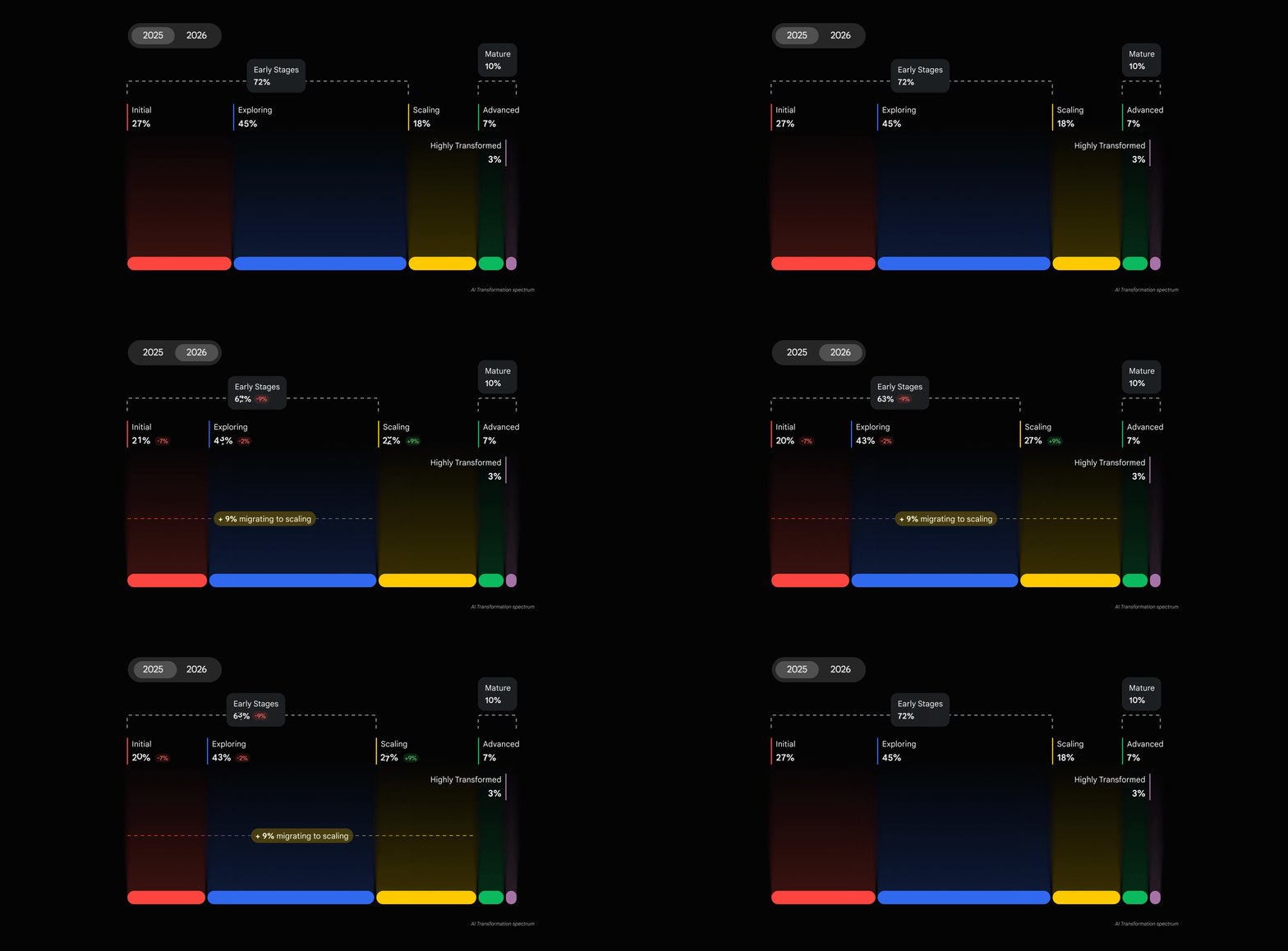
What does that all mean across enterprises? Essentially, everyone took a similar step forward and stopped at the same wall. Usage went up, but transformation stalled. The survey data helps to clarify where organizations get stuck, and, importantly, identify what’s working for those who have kept moving with AI transformation.
There are four things that mature organizations do differently.
- They redesign the work, not just the tool. Mature orgs are 10% more likely to say AI has fundamentally changed their business processes. Rather than layering AI on top of old habits, they rebuild the work itself: “Leaders know the win is not laying AI on top of existing processes, but actually redesigning the work,” said Dr. Terri Horton, a work futurist, author, and coach.
- They put AI where work already happens. 85% of mature organizations say companies need to move off legacy technology to transform (12 points higher than scaling organizations). Where AI sits determines how far it can reach. While most organizations (57%) agree that AI integration is important, mature companies actually act on it: they are far more likely than scaling businesses to demand that AI be built directly into their existing apps (36% vs. 22%).
- They can plan for what it costs. AI goals are quickly outpacing budgets, with 72% of organizations seeing costs outrun their financial plans and 68% worrying that those costs will spiral out of control. Mature organizations, however, are 14 percentage points more likely to understand these expenses well enough to plan for the long term (47% vs. 34%). The bottom line: You cannot redesign a workflow around a tool you’re rationing.
- They keep humans in control. 80% of respondents say AI makes human judgment more important, not less. Mature organizations are 18% more likely to say AI makes work more meaningful.
80% of respondents say AI makes human judgment more important, not less.
Beyond AI Optimism: Closing the Ambition Gap, 2026
AI agents raise the stakes for everyone.
While 97% of organizations are using or planning to use AI agents, the payoff scales with maturity. Highly transformed organizations accomplish 7.19 tasks per agent deployment, versus 3.37 for those just starting, with the biggest gap (42 percentage points — 71% vs. 29%) on making better use of company data.
However, scaling requires trust: 65% of organizations remain cautious about applying agents to more tasks, and only 35% of employees say there’s clear governance for what agents can handle independently. As Dan Turchin, CEO of PeopleReign and host of the AI and the Future of work podcast, notes: “Innovation can never move faster than the speed of trust.”
Where does transformation go next?
The gap between AI optimism and AI reality didn’t close this year — but I think it’s closeable. It requires leaders to stop counting hours saved, which is this decade’s vanity metric, and start asking harder questions:
- Have we redesigned the work?
- Is AI inside the tools people actually use, or bolted beside them?
- Do we know what it costs?
- Can an employee tell you what an agent is allowed to do on its own?
We built Gemini to solve these exact challenges. By embedding AI directly into the apps where work happens — grounded in your data, and backed by robust enterprise governance — we build tools that can help you scale AI safely and securely. In the end, the companies that transform won’t be the ones that used the most AI; they’ll be the ones that were truly ready for it.
Read the full report: Beyond AI Optimism: Closing the Ambition Gap 2026.